For one weekend in September the beachfront stops being about the surf. Road barriers go up along North and South Steyne, four stages appear between the sand and the shops, and a peninsula that normally empties by nine on a Sunday night fills with double basses.
Manly Jazz has run since 1977, which makes it the oldest continuously running jazz festival in Australia. It is free. It is non-ticketed. Nobody checks a wristband, because there aren't any. In 2026 it lands on Friday 18 to Sunday 20 September, with more than seventy acts across four outdoor stages and a dozen-plus indoor venues.
This is the local's version: what the weekend is actually shaped like, which room suits which mood, and the handful of logistics that separate a good Sunday from three hours looking for a park.

The basics
| Dates | Friday 18 – Sunday 20 September 2026 |
| Price | Free. Non-ticketed, no registration, no wristband |
| Scale | 70+ acts, four outdoor stages, 10+ official indoor venues |
| Where | Manly beachfront, the Corso and the surrounding blocks |
| Music | New Orleans trad through swing, soul, blues, gospel, roots, Latin and funk |
| Road closures | North and South Steyne, Raglan to Wentworth Street |
| Program | Announced by the council in August — check before you plan a day around one act |
The outdoor stages are free to everyone and always have been. The indoor venues are pubs and bars running their own programmed sets, so the entry is free but you're expected to buy a drink, and the good rooms fill.
Where it actually happens
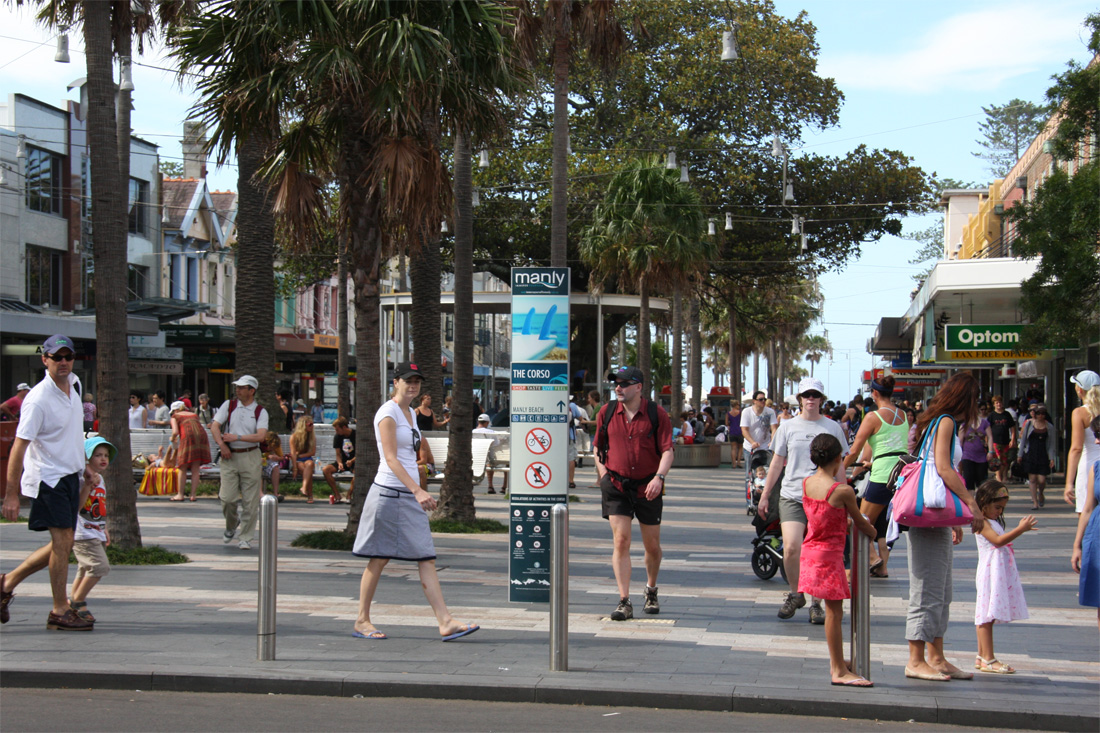
Understand the geography and the rest is easy. Manly's beachfront runs north–south along the Steyne; the Corso is the pedestrian spine running west from the sand to the ferry wharf. The festival occupies both, plus the streets either side.
The road closures on North and South Steyne are the thing to internalise. From Friday afternoon until late Sunday, the beachfront road between Raglan and Wentworth Street is shut to traffic and becomes the festival. That's also why driving in is a bad idea — more on that below.
Everything is walkable. The furthest official venue is a few minutes from the nearest, and the standard way to do the weekend is to drift rather than plan: catch twenty minutes of a set, hear something better down the road, follow it.



The four stages
The council confirms four stages for 2026 but hasn't yet published their names. Last year they were:
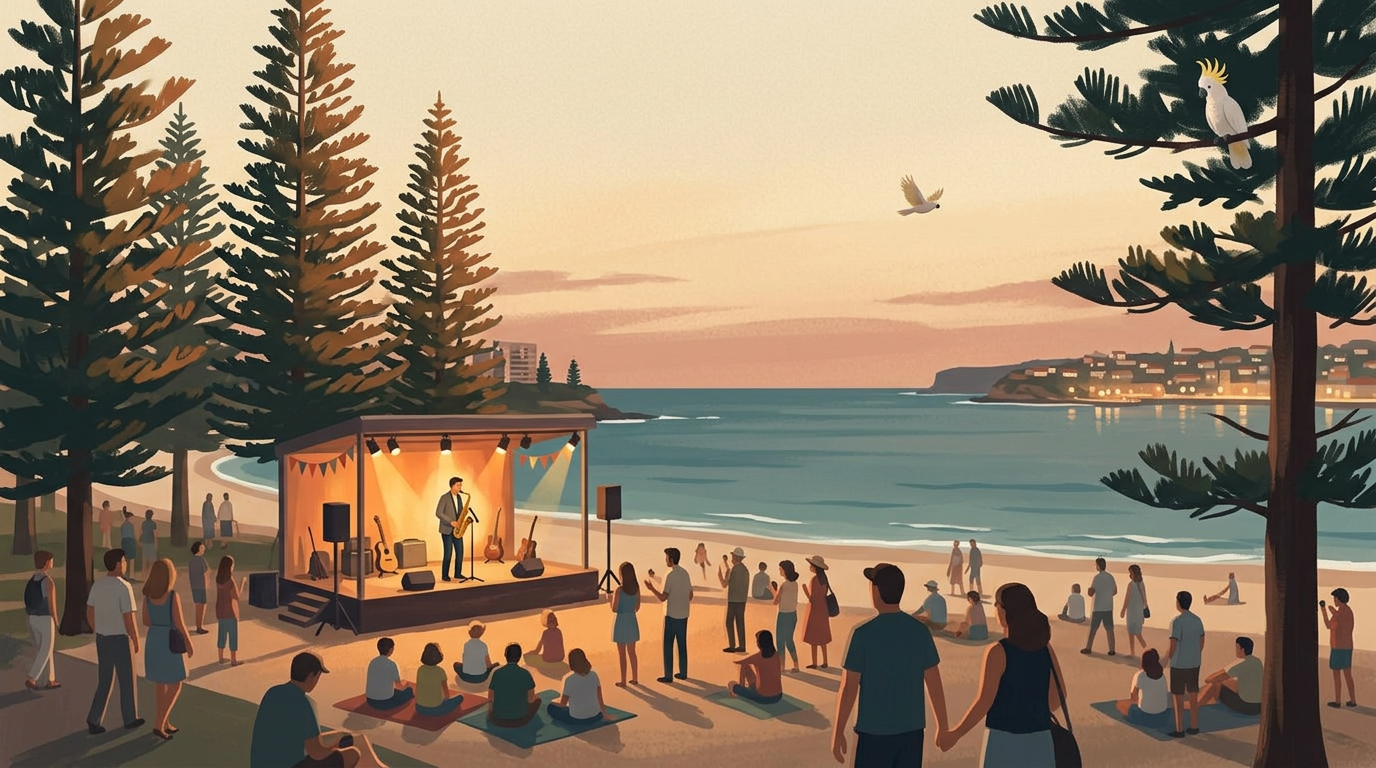
- Beachfront — the big one, on the closed section of the Steyne with the ocean behind the band. Headline sets, the largest crowd, and the stage people mean when they say "the main stage". Bring something to sit on; the good spots go early on Saturday afternoon.
- Sydney Road — smaller, tighter, closer to the pubs. Better acoustics than an open beachfront, and easier to actually see the players.
- Jazz Stars of the Future — student and youth ensembles. Genuinely worth an hour, and the least crowded stage of the weekend.
- St Matthews — a Saturday-only stage inside the church on the Corso. Different proposition entirely: seated, quiet, acoustically superb.
Treat that list as the likely shape rather than a promise. When the 2026 program lands in August, the stage names and the Sunday schedule are the two things worth re-checking.


The indoor venues, room by room
This is where the festival gets interesting, and where most first-timers never go. Ten to fifteen venues run their own programmed sets across the weekend — pubs, wine bars, a library, two churches.
The big pubs. Hotel Steyne sits at the beach end of the Corso and is the loudest, busiest option — multiple levels, several rooms, and a crowd that treats jazz as a soundtrack rather than a recital. The New Brighton Hotel is on the corner opposite, all wraparound verandah and street views, and the balcony is one of the best free seats in Manly. The Ivanhoe is further up the hill and holds its crowd later than most.
The wharf. Felons Manly Wharf has the water, the space and the brewery, and it is the natural last stop if you're catching a ferry home. It's a five-minute walk from the beachfront stages down the Corso — see the Manly Wharf guide for what else is down there now.
The smaller rooms are where the actual listening happens. InSitu, Donny's Bar, The Cumberland, Henry G's and Cibaria on North Steyne each take a handful of acts. Fewer people, closer to the band, and you can hear the bass. If you only do one indoor venue, make it one of these rather than a big pub.
The odd ones, which are the best ones. Manly Library has run a Friday-night open mic. St Matthew's on the Corso hosts a Saturday stage. Manly Presbyterian Church has run a Sunday-morning jazz gospel service — free, open to anyone, and a genuinely unusual way to start the last day. These are the sets locals talk about afterwards.


Getting there: take the boat
Come by ferry. This is not a preference, it's the whole answer.
The F1 from Circular Quay runs every twenty to thirty minutes and takes half an hour, and it drops you at the wharf a four-minute walk from the stages. On a festival weekend it's faster than driving, cheaper than parking, and it removes the entire problem of getting home. The local's guide to the ferry covers Opal fares, timetables and which side to sit on.
The B-Line bus runs from the city and down the Northern Beaches from about 4:30am to 12:30am, seven days. It's the right call if you're coming from Dee Why, Mona Vale or Newport rather than the city.
If you must drive, know what you're driving into. The beachfront road is closed. Manly's four paid parking stations show real-time availability on the council website, and on a Saturday afternoon in September they will be full. Add the road closures and you have the worst parking weekend of the year outside summer. Read where to park in Manly first, park well back from the beach, and walk in. Or don't drive.
Eating between sets
Manly's food problem during Jazz is not quality, it's queues. Two rules make the weekend work.
Book anything you actually care about, especially Saturday dinner and especially the waterfront. Tables that sit empty on an ordinary September Tuesday are gone by Wednesday of festival week.
Otherwise, eat off-peak or eat on the move. The Corso and the streets running off it are dense with counter-service options, and a fish and chips on the sand between sets is a better festival lunch than any table. The full guide to eating in Manly has the whole picture; the restaurant directory filters by cuisine and price if you want something specific near a particular stage.
One local note: if you want a sit-down dinner with the festival still audible but not on top of you, book something a block back from the Steyne rather than on it.


Where to stay, and when to book
Manly has around seven hotels worth booking and a few hundred apartments. That is a small amount of accommodation for a weekend that draws thousands of people, and September is already the start of the shoulder season climb.
Book now, not in September. Rates on the beachfront roughly double for the festival weekend and the good rooms go months out. Our best hotels in Manly guide ranks the realistic options, and the full directory lists everything.
If it's sold out — and it will be — staying in the city and catching the ferry over each morning is a perfectly good plan B. You get the harbour crossing twice a day, which is not the worst commute.
A plan for each day
Friday. Things start in the evening. Road closures go up in the late afternoon and the indoor venues carry the night — this is the pub-crawl day, and the library open mic is the sleeper pick. Lower crowds than the weekend, and the town has a nice restless quality to it.
Saturday. The big day. Beachfront stage from the middle of the day, St Matthew's for something quieter in the afternoon, and the pubs from early evening onward. Get to the main stage before the headline set if you want to sit. Expect the Corso to be genuinely packed between two and six.
Sunday. The best day, and most visitors have gone home. Start with the gospel service if it runs again, spend the afternoon stage-hopping, then take an early-evening ferry back with the light going pink over the harbour. Sunday finishes at a civilised hour — the closures lift late, but the crowd thins from about seven.
What to bring
- Something to sit on. A towel or a folding chair. The beachfront stage is standing and sand.
- A jumper. September in Sydney is spring on paper and cold by nine at night, with a sea breeze.
- Cash is optional but useful at the smaller stalls.
- Sunscreen. Spring UV in Sydney is stronger than northern-hemisphere visitors expect, even at 20°C.
- Not the car. See above.
A short history
The first Manly Jazz ran in 1977, when the beachfront was a very different place and a free outdoor jazz festival was an odd idea for a surf suburb. It stuck. Nearly fifty years later it is the oldest continuously running jazz festival in the country and the largest annual event on the Northern Beaches calendar.
It has stayed free that entire time, which is the part locals are quietly proud of. There is no VIP enclosure and no tiered ticketing. You turn up, you stand on a public street, and you listen.

The short version
18–20 September, free, no tickets. Come on the ferry. Saturday is the biggest day and Sunday is the best one. See at least one set in a small room rather than only the beachfront stage. Book a bed and a Saturday dinner table now, not in September. Bring a jumper.
The rest of the year's calendar — the Surf Open, Taste of Manly, the Cole Classic and New Year's Eve — is on the festivals and events page.
Photo credits
Every photograph here comes from Wikimedia Commons and is used under a Creative Commons or public domain licence. In order of appearance:
- Opening — Jorgio El Zein (CC BY-SA 4.0)
- Where it happens — Maksym Kozlenko (CC BY-SA 3.0); unknown photographer (public domain); Stefano (CC BY-SA 3.0); Maksym Kozlenko (CC BY-SA 3.0)
- The four stages — Jorgio El Zein (CC BY-SA 4.0) ×2
- The venues — Stefano (CC BY-SA 3.0); grumpylumixuser (CC BY 3.0); Orderinchaos (CC BY-SA 4.0); Sardaka (CC BY-SA 4.0); Blank-2018 (CC BY-SA 4.0)
- Eating between sets — Maksym Kozlenko (CC BY-SA 3.0) ×3
- A short history — William Henry Broadhurst, State Library of NSW (public domain)