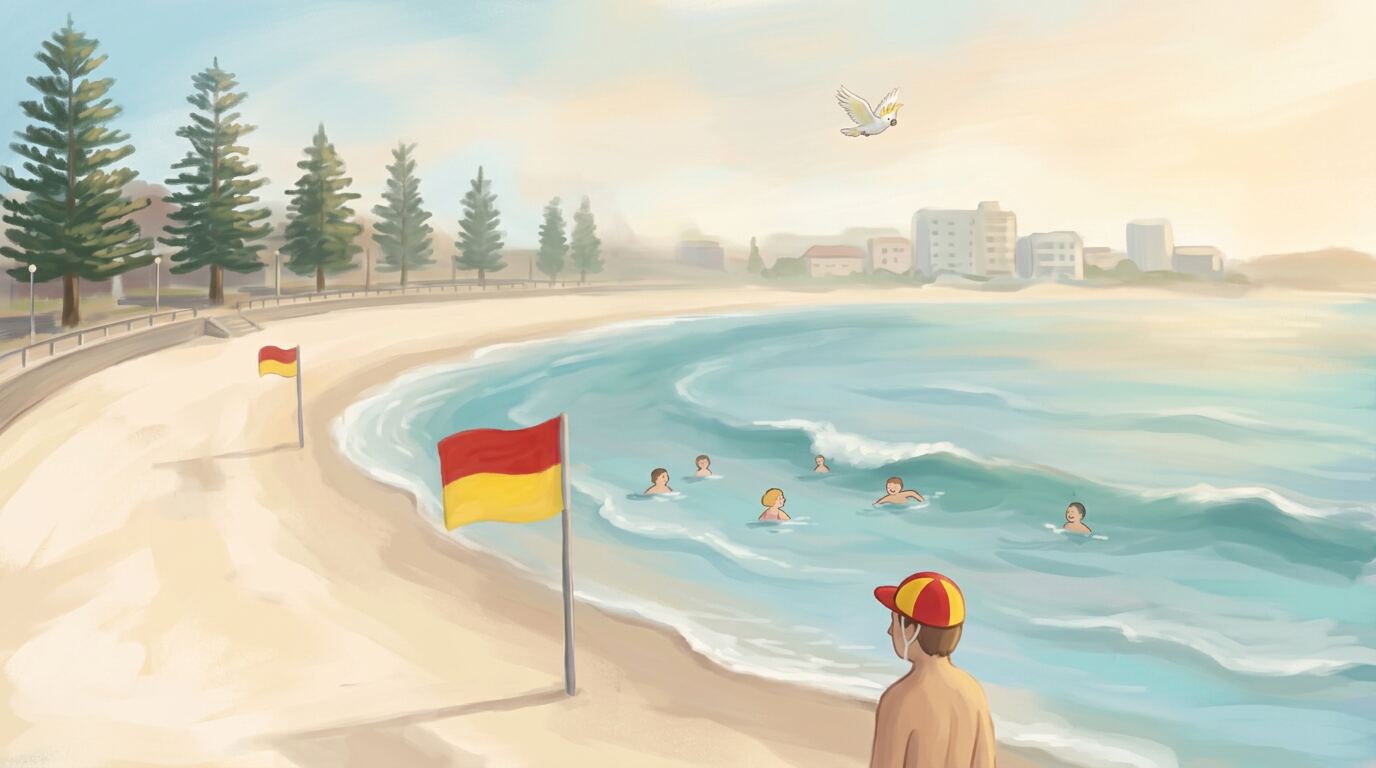
Short answer: yes. Manly is one of the safest places to swim in Australia. It has a patrolled ocean beach, a netted harbour beach, four ocean rock pools and a protected bay, and on a normal summer day tens of thousands of people get in the water and every one of them walks back up the sand.
But "safe" here means safe if you do a few specific things, and the specific things aren't obvious if you didn't grow up with them. Australian beach safety is taught to kids here from about age five and then never explained to anyone again, which is why visitors end up in trouble at a rate wildly out of proportion to their numbers. Almost none of that trouble involves sharks. Most of it involves a current, a flag that wasn't there, or an afternoon of sun.
So this is the honest version — the things a local would actually tell you before you walked down to the water.
The one rule that does most of the work
Swim between the red and yellow flags.
That's it. That is the single highest-value piece of advice on this page, and it's worth more than everything below it put together. The flags are not decoration and they're not a suggested area — they are a patch of water that trained surf lifesavers have chosen this morning, based on today's sand banks and today's currents, as the safest water on the beach, and which they are actively watching while you're in it. They move the flags through the day as conditions change.
Australia-wide, the number of people who drown between the flags on a patrolled beach in a given year is usually zero or close to it. The drownings happen on unpatrolled beaches, outside the flags, or outside patrol hours. The flags work.
If you take nothing else: find the flags, swim between them, and you have removed the large majority of the risk.
Reading the flags and signs
Not every flag on an Australian beach means the same thing.
- Red and yellow, a pair — the patrolled swimming area. Swim between them. This is where the lifesavers are looking.
- Red flag alone — the beach is closed. Don't swim. Conditions are dangerous enough that the club has shut the water, and it's usually a big swell, a strong rip or poor visibility. It happens at Manly a handful of times a season.
- Yellow flag alone — potentially hazardous, swim with caution. Strong swimmers only, and keep it shallow.
- Black and white quartered — the surfcraft area, for boards and kayaks. Not a swimming zone. Don't swim here and, if you're on a board, don't ride through the red-and-yellow zone.
- No flags at all — no patrol. The beach isn't closed, but nobody is watching you.
The yellow signs at every beach access point carry the hazard symbols for that beach. At Manly you'll typically see warnings for strong currents, sudden drop-offs and surfcraft. They're worth ten seconds of your time.
Where and when Manly is patrolled
Manly Beach — the long ocean beach — is patrolled, but not all of it and not all year.
- Volunteer surf lifesavers (the red-and-yellow caps) patrol on weekends and public holidays from about late September to late April, the traditional season.
- Council lifeguards (the blue and yellow uniforms) work weekdays through the same period, and cover the peak summer months daily.
- Patrol hours are usually somewhere around 9am to 6pm, longer in January, shorter at the shoulders.
The flagged zones are typically set in front of the Manly Life Saving Club at mid-beach, at North Steyne, and at Queenscliff, though on any given day the number and position depends on staffing and conditions. On a big January weekend you might have three flagged areas along the beach; on a grey Tuesday in May you might have none.
Outside those hours and outside that season, nobody is watching the ocean beach. Winter swimming at Manly is genuinely lovely and locals do it every day, but it's an unpatrolled swim and you should treat it as one.
What is not patrolled, ever:
- Shelly Beach and Cabbage Tree Bay — calm, beloved, and unpatrolled.
- Fairy Bower Pool, Queenscliff Rockpool, Fairlight Rockpool — no lifeguards at any Manly ocean pool.
- Manly Cove, Little Manly Cove, Fairlight Beach, Forty Baskets — the harbour beaches.
None of that means avoid them. It means know that if something goes wrong there, the response is whoever else happens to be in the water. Take a friend.
Rip currents: the actual danger
Rips are the thing that hurts people at Australian beaches. They cause the overwhelming majority of surf rescues and most coastal drownings, and they are almost entirely a problem of not recognising them.
A rip is simply the water that the waves pushed onto the beach finding its way back out to sea. It gathers into a channel and flows offshore, and it can move faster than an Olympic swimmer can sprint. You cannot beat one by swimming against it — that's exactly what exhausts people.
How to spot one from the sand. Stand up on the promenade or a dune and look for a couple of minutes before you go in. A rip usually looks like:
- A darker, deeper-looking channel of calmer water running out through the surf.
- A gap in the line of breaking waves — waves breaking to the left and right, but not in that patch.
- Rippled or churned water where the surface around it is smooth.
- Foam, sand or seaweed being carried steadily out past the break.
The counter-intuitive part is that a rip often looks like the nicest place to swim — flat, calm, no waves crashing on your head. That calm patch is the escalator heading out to sea. The white, messy, breaking water either side of it is the safe part.
If you're caught in one. This is the sequence, and the first two steps matter most:
1. Don't panic and don't fight it. Panic and exhaustion are what actually drown people, not the current itself. A rip pulls you out, not under. 2. Float. Lie on your back, keep your head above water, and let it take you. Rips weaken and dissipate, usually within 50 to 100 metres of shore. You will stop moving out. 3. Raise one arm and wave for help. If you're at a patrolled beach, you have been seen already. 4. If you're a confident swimmer, swim parallel to the beach — towards the white water where the waves are breaking — until you're out of the channel, then let the waves help you in.
Floating is the advice that has changed in the last decade or so, and it's the one to remember. You do not have to escape the rip. You have to stay afloat and calm until help arrives or the current lets you go.
Manly's rips shift with the sand banks, but there's usually a persistent one at the Queenscliff end near the lagoon outlet, and often one working against the South Steyne corner. Surfers use them deliberately as a free ride out the back. That should tell you how strong they are.
Bluebottles
If you get stung at Manly, this is what stung you.
The bluebottle (Physalia utriculus, the Pacific man o' war) is a small blue float with a long trailing tentacle. They're not jellyfish and they don't swim — they sail, which means they arrive in fleets when the wind blows onshore.
Season and conditions. Bluebottles turn up at Manly from roughly October through April, peaking in summer, and specifically on days with a sustained north-easterly wind — the classic Sydney summer sea breeze. After a few days of NE wind you'll see them stranded in a blue line along the tide mark. That blue line is the warning: if the sand is covered in them, the water has them too. Lifesavers often post a bluebottle warning sign on the beach on those days.
The sting is a sharp, immediate, burning line of pain and a red welt, and it usually eases over an hour or so. For most people it is unpleasant and not dangerous. Tentacles still sting when the animal is dead and stranded on the sand, so don't let children pick them up.
First aid (this is the current Australian guidance, and it has changed — ignore older advice):
1. Get out of the water. Pick off any tentacles still stuck to the skin, with fingers if you have to — the sting on your fingertips is negligible. 2. Rinse the area with seawater, not fresh water. Fresh water can make undischarged stinging cells fire. 3. Do not use vinegar. Vinegar is for tropical box jellyfish and makes bluebottle stings worse. 4. Immerse in hot water — as hot as you can comfortably tolerate, around 45°C, for about 20 minutes. A hot shower works. This is genuinely effective for the pain. 5. If hot water isn't available, a cold pack is the second choice. 6. Call 000 if there's any chest pain, difficulty breathing, widespread symptoms, or a sting to the face or throat. That's rare, but it's the line.
Manly's surf clubs and the council lifeguard towers carry first aid and see a lot of these. Ask them — that's what they're there for.
Sharks: the honest answer
You want the real number, so here it is: the risk is very low, much lower than you think, and it is not zero.
Sydney has had one fatal shark attack in the last sixty years — at Little Bay in February 2022, which broke a run stretching back to 1963. Sydney Harbour itself has not had a fatality since 1963. Against that, several million people swim at Sydney beaches every summer. You are at far, far greater risk driving to the beach than swimming at it, and greater risk again from the sun once you're there.
What's actually in the water at Manly:
- Cabbage Tree Bay has a resident population of grey nurse sharks, especially around the deeper reef in winter. They look prehistoric and alarming, with ragged teeth showing. They are functionally harmless to swimmers and are a threatened, protected species. Snorkellers seek them out deliberately. Leave them alone and they'll ignore you.
- Port Jackson sharks — small, blunt-headed, bottom-dwelling — are common in the reserve in winter. Completely harmless.
- Wobbegongs rest under ledges. They will bite if you stand on one or grab its tail. Don't do that.
- Bull sharks move into Sydney Harbour in warmer months, generally in murkier upper-harbour water. This is the one that informs the sensible precautions below, not anything on the ocean side.
Sensible precautions, which locals actually follow without thinking about it:
- Use the netted enclosure at Manly Cove if you want harbour swimming with a barrier. Little Manly and Forty Baskets have enclosures too.
- Don't swim at dawn or dusk in the harbour, and not in murky water after heavy rain — that's when and where bull sharks feed.
- Don't swim near people fishing, or where bait fish are schooling and birds are diving.
- Take off shiny jewellery. Swim with others.
- NSW runs shark meshing, drone surveillance and SMART drumlines along this coast in the warmer months. The nets are not a barrier and were never designed as one — treat them as irrelevant to your personal decision-making.
If a shark alarm sounds — a long siren from the surf club — get out of the water calmly and promptly. It is almost always a precaution after a drone spot.
The thing that will actually get you: the sun
More visitors have their Manly trip ruined by sunburn than by every marine creature combined, and Australia has the highest rate of skin cancer in the world for a reason.
The UV here is not comparable to a European or North American summer. Sydney routinely hits UV index 11–13 in December and January, which is rated "extreme". At that level, unprotected fair skin burns in about ten minutes. The water reflects it, the wind hides the heat, and you will not feel it happening until it's done.
- SPF 50+ broad spectrum, applied 20 minutes before you go out, and reapplied every two hours and after every swim. No sunscreen is waterproof.
- A rash vest is the single most effective thing you can do, and it's completely normal here — half the beach is wearing one.
- Hat, sunglasses, shade. The Norfolk Island pines along the promenade and the shade sails at Manly Cove are the usable shade on the beach itself.
- Avoid 10am–3pm in midsummer if you can. Locals swim early and late for exactly this reason — the 7am swim isn't just about calm water.
- Check the UV index rather than the temperature. It's high on cool days and cloudy days too; cloud does not stop UV.
Water quality and when not to swim
Manly's ocean beach is graded Good to Very Good by the NSW Beachwatch program in almost all conditions, and the harbour beaches are usually fine. The exception is rain.
Sydney's stormwater runs into the sea. After heavy rainfall, bacterial levels rise sharply at outlets and in enclosed water. The standard local rule:
- Ocean beaches: wait about 24 hours after heavy rain.
- Harbour and estuarine beaches — Manly Cove, Little Manly, Fairlight: wait up to three days. Enclosed water flushes slowly.
- Avoid the Manly Lagoon outlet at the Queenscliff end of the beach entirely after rain — that's the local hot spot, and it's why the northern corner is worth skipping on a wet week.
- Don't swim in visibly discoloured water, or near stormwater drains, dead fish or foam lines.
Beachwatch publishes daily pollution forecasts for Sydney beaches online. On a clear week in summer you can ignore all of this. On the Tuesday after a big east coast low, don't.
The other things worth knowing
The shore dump. On days when the bank is steep, the wave at South Steyne breaks directly onto the sand with real force. Neck and shoulder injuries from being dumped in ankle-deep water are one of the more common serious injuries at Australian beaches, and it catches confident adults, not children. If the waves are landing with a thud rather than a rolling break, don't dive in headfirst or turn your back on them.
The ocean pools in a swell. Queenscliff Rockpool and Fairy Bower are cut into the rocks and wash through when the surf is over about 2 metres. Getting swept off the wall or scraped across it is a genuine hazard. On a big day, admire them from the path. Fairy Bower is cleaned on Wednesdays and Fairlight on Thursdays — the pools drain, so check before you plan a swim.
Rock platforms and rock fishing. Never turn your back on the ocean on the rocks below North Head or around the Bower. Rock fishing is the single most lethal recreational activity in NSW, and the deaths are from being washed in, not from anything in the water.
Cold. August water sits around 16–17°C. That's cold enough for a cold-water gasp reflex on entry if you're not used to it. Get in gradually, control your breathing before you start swimming, and don't do a winter swim alone if it's your first.
Alcohol. A large share of Australian coastal drownings involve alcohol. The beer belongs at the end of the swim.
If something goes wrong
- Emergency: call 000 and ask for Police, then say you need the Marine Area Command or Surf Life Saving. From a mobile at the beach, 000 works.
- On a patrolled beach, raise one arm straight up and wave — that's the recognised signal for help, and lifesavers are scanning for it.
- If you see someone in trouble, don't swim out to them. Untrained rescuers drown at a horrifying rate, most often parents going in after kids. Alert a lifeguard, call 000, and throw something that floats — an esky lid, a boogie board, a bodyboard.
- Emergency Response Beacons and marker signs along the coastal walk give a location code to read out to the operator. If you're on the cliff path, look for one.
- The free Beachsafe app from Surf Life Saving Australia lists patrol times, hazards and today's conditions for every beach on this coast. It's the one app worth installing before you get here.
So — is it safe?
Manly is about as safe as an open ocean beach gets. It's patrolled by one of the oldest and most competent surf lifesaving operations in the world, it has a netted harbour beach for anyone who wants a guaranteed calm swim, and the marine life ranges from harmless to actively delightful.
The risks that matter are, in order: the sun, rip currents, swimming outside the flags or outside patrol hours, and the shore dump on a steep day. Sharks are not on that list in any honest ranking.
Read the flags, swim between them, look at the water for two minutes before you get in, wear a rash vest, and Manly will be the best swim of your trip. That's not a disclaimer — that's just how everyone here does it.
Keep reading
- Swimming in Manly: the best spots — where to swim, by what you actually want out of the water.
- Manly's ocean pools and sea baths — all six saltwater swims, in photos.
- Snorkelling with blue gropers at Shelly Beach — what you'll see in Cabbage Tree Bay.
- Manly Beach: the surf and family guide — the flags, the banks and the beginner sections.
- Learn to surf in Manly — schools, lessons and gear.
- Things to do in Manly with kids — the netted-and-shallow version of the whole town.
- Manly weather and water temperatures — month-by-month numbers.
Source: Manly Hydraulics Laboratory SST · Bureau of Meteorology
Plan your day
Tell us who's swimming and how confident they are, and we'll build a day around the right water — flags, tides, ferry times and a coffee at the end. Build my itinerary →


