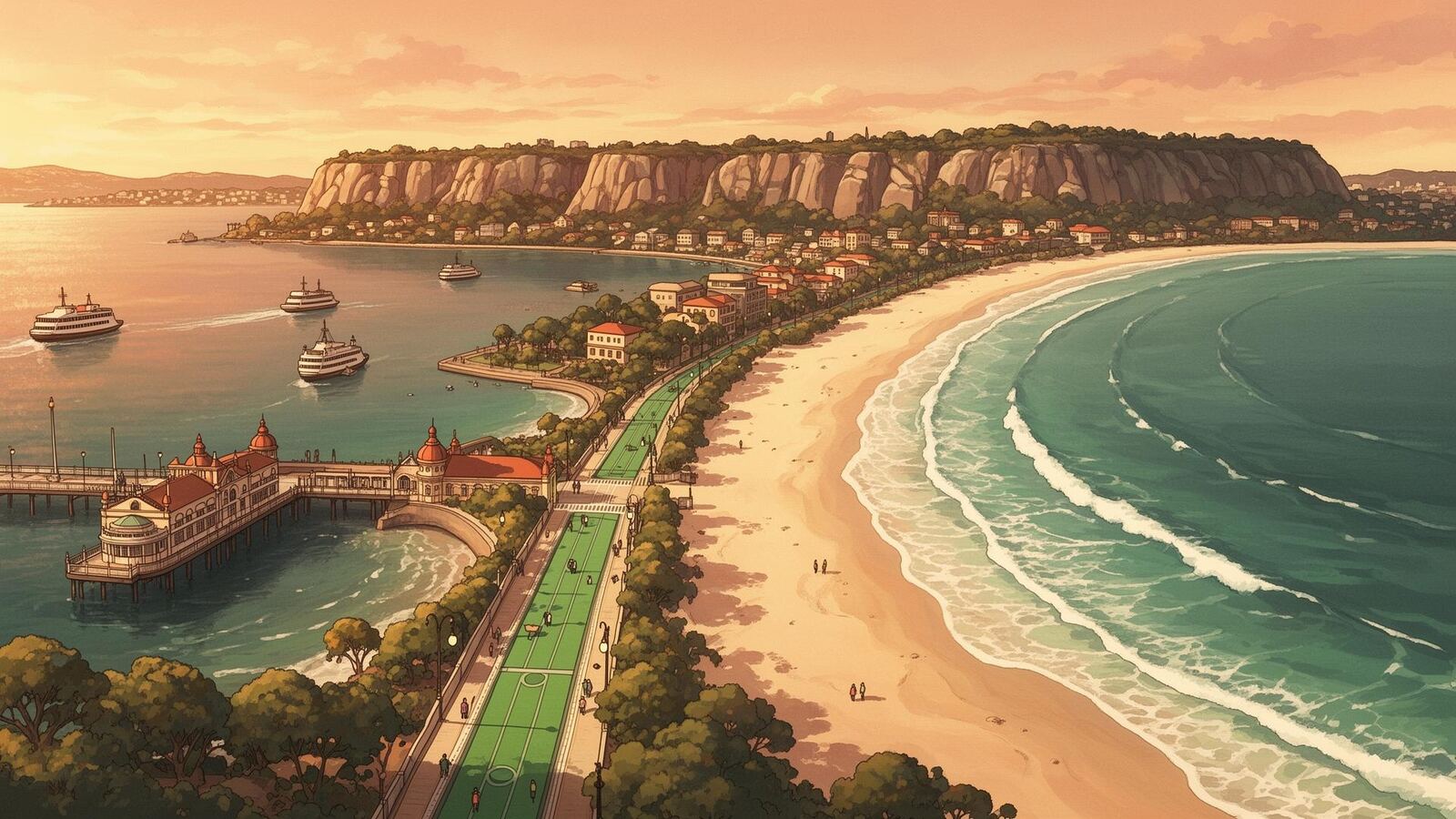
Most visitors see Manly as a beach. Locals know it is also a peninsula, and that the peninsula has a head: a great sandstone fist of bushland called North Head, sticking out into the mouth of Sydney Harbour. It is one of the most spectacular pieces of coastline anywhere in Australia, and it carries more history per square metre than almost any other patch of ground in the country.
This is a long read. Pour something. We are going to walk through 200 million years of geology, 20,000 years of Gayamaygal custodianship, the arrival of the First Fleet, four pandemics, a quarantine station, a hotel that grew out of it, and, at the very end, a ghost tour that we will treat with the seriousness it absolutely demands.
Deep time: the sandstone the city sits on
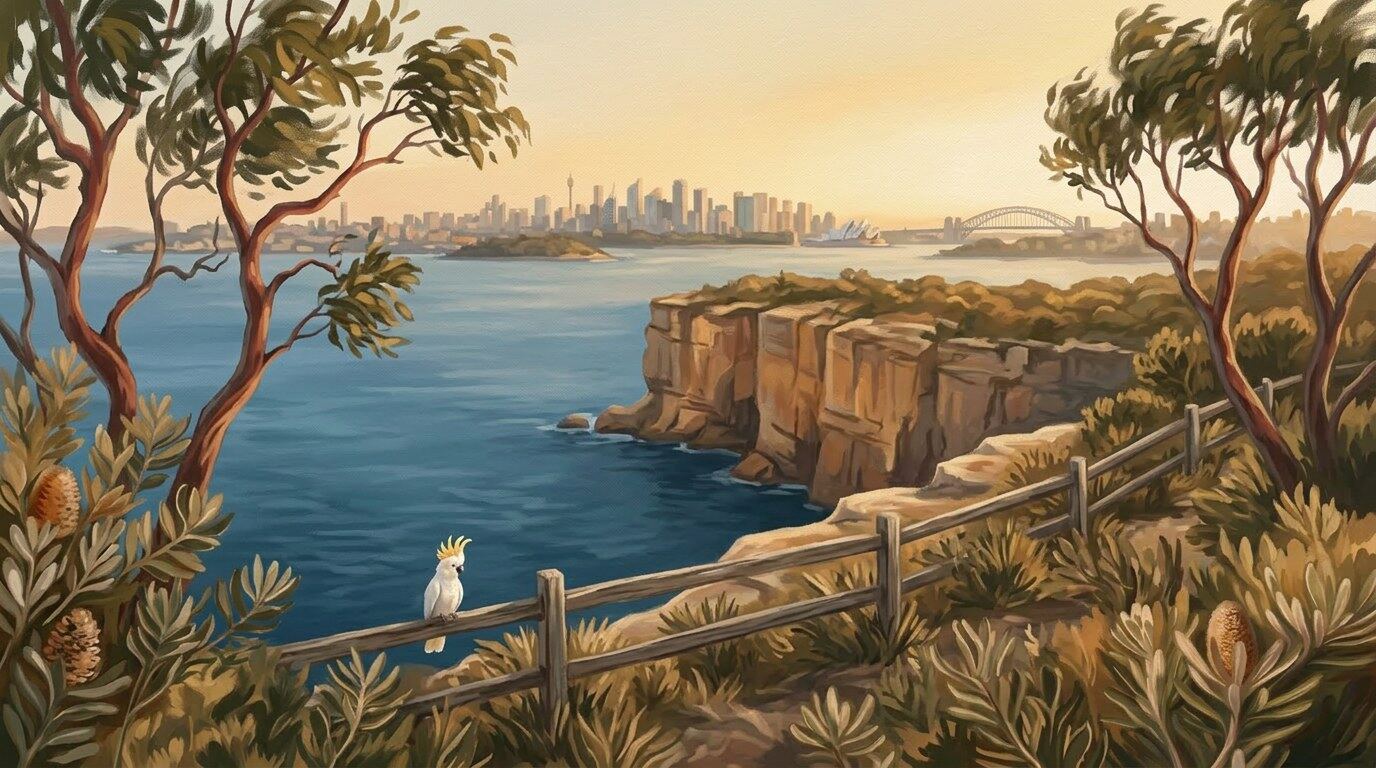
The cliffs at North Head are Hawkesbury sandstone, laid down by an enormous river system about 230 million years ago when this part of the world was a warm, low basin draining into a long-vanished sea. Walk the Fairfax track and you can read the geology like a book — cross-bedded sand grains tilting in the direction the river once flowed, ironstone bands the colour of rust, and tafoni honeycomb weathering on the seaward faces where salt has been slowly chewing the rock for millennia.
The drama of the Heads themselves — North and South facing each other across a narrow ocean gateway — is much more recent. At the end of the last ice age, around 10,000 years ago, sea levels rose roughly 130 metres and drowned what had been a deep river valley. The river is still there, in a sense; we just call it Sydney Harbour now, and we sail across it on the Manly Ferry.
Gayamaygal Country
North Head is the traditional Country of the Gayamaygal people (sometimes written Cannalgal), one of the clans of the Eora nation. They have been here, by the most conservative archaeological estimates, for over 20,000 years — long enough to remember the harbour as a valley.
Middens, rock engravings, grinding grooves and ceremonial sites survive across the headland. The Gayamaygal name for North Head is Car-rang-gel; the broader area, including Manly Cove, has long been a place of ceremony, of fishing from bark canoes called nawi, and of gathering. The NSW National Parks & Wildlife Service works closely with Gayamaygal knowledge-holders today; please walk lightly, stay on tracks, and leave anything you find where it is.
How Manly got its name
The European story begins, abruptly, on 21 January 1788. Governor Arthur Phillip, exploring Port Jackson by boat just days after the First Fleet reached Botany Bay, and before the colony moved to Sydney Cove, stepped ashore at what is now Manly Cove. He encountered a group of Gayamaygal men, and was struck by their bearing. The full story is in why Manly is called Manly.
In his own words, the "confidence and manly behaviour" of the men he met led him to name the place Manly Cove. The word stuck — first to the cove, then the beach, then the town. It is, if you stop and think about it, an extraordinary origin: a Sydney suburb named by a passing English admiral as a compliment to the people whose Country he had just landed on uninvited.
The complication, of course, came next. Within months, the smallpox epidemic of 1789 swept through the Sydney clans. Phillip's "manly" hosts were among the first to die. The Gayamaygal survived, and their descendants are still here; but the cost of that first meeting is a thread that runs through everything else on North Head.
The wildlife: a small ark, ten kilometres from the GPO
North Head is one of the last places on the Sydney mainland where you can still see Australian bush mammals going about their evening business. The headland is fenced from the suburbs by an old sandstone wall and a stretch of bushland, and the Sydney Harbour Federation Trust and NPWS have spent two decades quietly rewilding it. The result is genuinely lovely.
Long-nosed bandicoots
The headline act. Long-nosed bandicoots (Perameles nasuta) are pointy-faced, rabbit-sized marsupials that snuffle for grubs in the leaf litter at dusk. The North Head population is one of only two endangered mainland populations left in Sydney. If you walk the Fairfax loop or the North Fort tracks in the half-hour after sunset, you have a very good chance of seeing one cross the path in front of you. They will pretend you do not exist. Return the favour.
Short-beaked echidnas
Echidnas (Tachyglossus aculeatus) have been quietly recolonising North Head over the last decade — they were locally extinct here for most of the twentieth century. They potter along the same tracks the bandicoots use, looking for ants and termites, and they are not bothered by humans. If you see one, stop and watch; they are one of only two egg-laying mammals on Earth and the other one is a platypus.
Little penguins
The last mainland breeding colony of little penguins (Eudyptula minor) in NSW lives on the harbour side of North Head, between Manly Cove and Spring Cove. They come ashore at night in winter and spring to nest under rocks and in stormwater pipes. The colony is critically endangered and very closely protected — there is no public penguin viewing, and bringing a dog into the area carries serious penalties. Mention them quietly, admire them from a distance, and feel pleased that they are still there at all.
Birds — and the cockatoo problem
NPWS lists more than 150 bird species on North Head. Realistically, you will see sulphur-crested cockatoos (loud, brilliant, completely unbothered by you), rainbow lorikeets, kookaburras, eastern whipbirds (heard before seen), and white-bellied sea eagles wheeling over the cliffs. Sit on a bench at Fairfax for ten minutes and the cockatoos will inspect you for biscuits. Do not feed them. They do not need biscuits. They need to keep being weird wild parrots that live on a cliff.
Humpback whales, May to November
From late autumn through to spring, North Head is one of the best whale watching lookouts in Sydney. Humpbacks pass close to the headland on their northern migration to the Queensland breeding grounds in winter, and again on the southern return with calves in spring. Pack binoculars and look for the puff of a blow first; the body usually follows.
Source: ORRCA sightings log · NSW NPWS Wild About Whales · operator records 2018–2024
Colonial fortifications and the artillery years
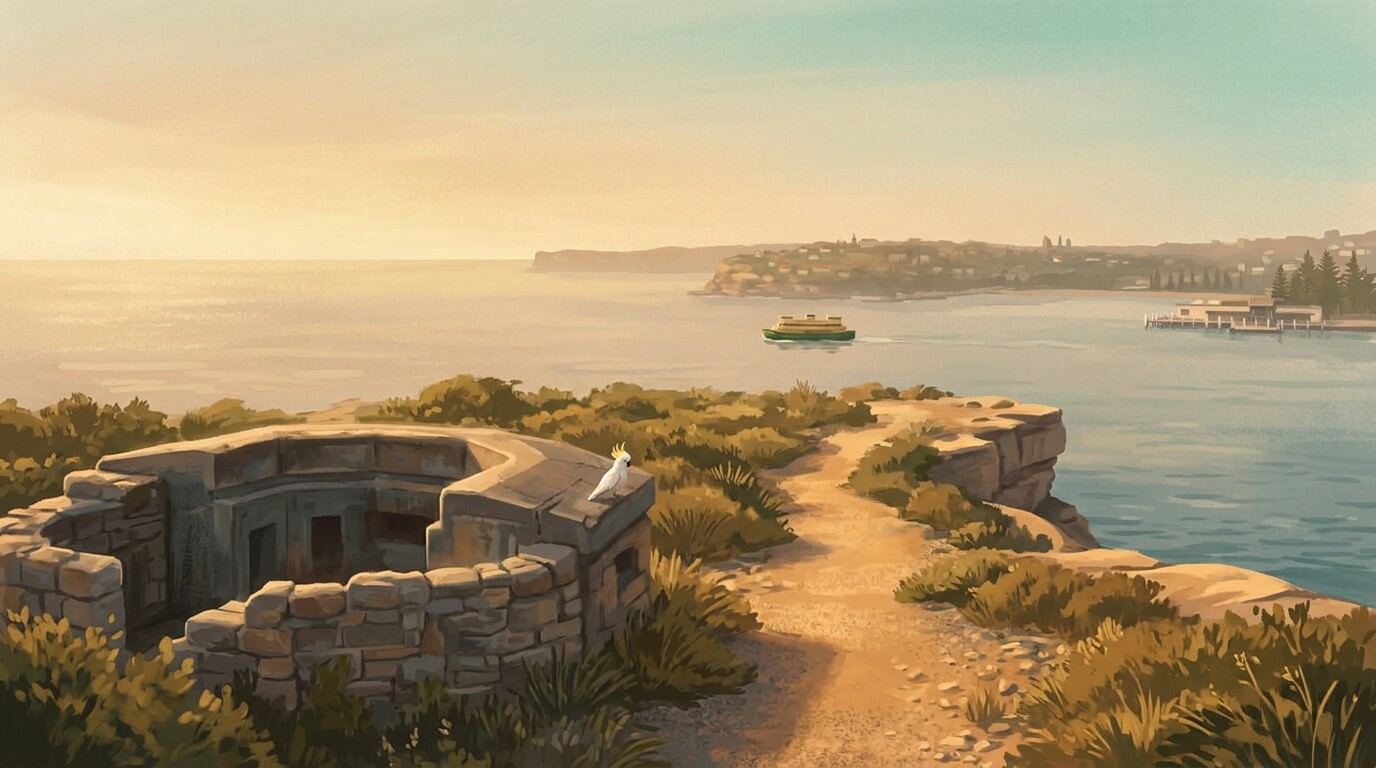
Walk inland from Fairfax and you start to find concrete. North Head was militarised from the late nineteenth century onwards, and the headland still carries the bones of a major coastal defence: North Fort, the WWII gun emplacements, ammunition tunnels you can walk through on tours, and the School of Artillery which trained Australian gunners from 1937 to 1998.
Most of it is now part of a public memorial and museum precinct managed by the Royal Australian Artillery Historical Society. The tunnels are surprisingly cool in summer, faintly damp in winter, and a useful reminder that the same cliffs we now sit on for sunset photos were, within living memory, the city's last line of defence against a feared seaborne attack.
The Quarantine Station: 1832 – 1984
This is where North Head gets, quite literally, world-significant.
Between 1832 and 1984, a deep sheltered cove on the harbour side of the headland served as Sydney's Quarantine Station — the place where every ship arriving in the colony with sickness on board was sent to wait. The reasons were entirely practical: prevailing northeasterly winds blew germs out to sea instead of into the city, the cove was easy to seal off, and the deep water let ocean-going ships anchor right up to the jetty.
Across more than 150 years, somewhere around 13,000 people were quarantined here. Around 580 are buried in the station's three small cemeteries. The diseases held at the gate read like a grim survey of nineteenth- and twentieth-century maritime medicine:
| Outbreak | Years | Notes |
|---|---|---|
| Smallpox | 1881–82, 1913 | Hundreds detained from infected ships; entire vessels held offshore for weeks |
| Bubonic plague | 1900–03 | Rats from the wharves; Sydney had its own outbreak, the Station was a release valve |
| Spanish flu | 1918–19 | Returning WWI troopships were diverted here; the worst single year for deaths |
| Typhus, cholera, scarlet fever | recurring | Crew and migrants from European voyages |
| Asian influenza | 1957 | The last major quarantine event before air travel made the station obsolete |
What survives today is, by global standards, astonishing. The sandstone walls of the hospital, the disinfecting block where clothes were steamed, the showers, the morgue, the segregated first-, second- and third-class accommodation, the cemeteries, and most movingly the wharf inscriptions — over a thousand messages carved by detainees into the soft sandstone of the shoreline, each one the name of a ship, a date, sometimes a family. It is one of the most significant maritime heritage sites in the Southern Hemisphere, and it is largely intact because the headland's military status kept developers out for a century.
Q Station today
In 2006, after decades of public debate, the old Quarantine Station was leased on a long tenure to a private operator and quietly, carefully, adaptively reused as a hotel. It is now run by Accor as the Q Station Sydney Harbour National Park — a 4-star resort scattered across the original quarantine buildings, with day-visitor access, restaurants open to the public, a small museum, a beach (Quarantine Beach), and what may genuinely be the best harbour views of any hotel in Sydney.

The key thing to understand is that Q Station is inside a national park. There are no chain-hotel pretensions and no infinity pool. Instead you get heritage cottages where the sash windows still rattle in a southerly, sandstone steps worn into hollows by 150 years of feet, and a 5-minute shuttle that meanders you down to dinner at the Boilerhouse.

If you want to stay, here is the room and the reviews:
#2 · Cliffside retreat inside a national park
Q Station Sydney Harbour National Park (by Accor)
- Price
- from A$182 to A$400+
- Walk to Manly Beach
- 25 minutes walk into the village (or 5 minutes by free shuttle)
- Address
- 1 North Head Scenic Drive, Manly NSW 2095
The most unusual hotel in Sydney, by some distance. Set inside Sydney Harbour National Park on North Head — the old quarantine station for arriving migrants, now a sprawling sandstone-and-weatherboard retreat with its own beach (Quarantine Beach), bandicoots in the bush, and the best harbour views in the city from the cliffside rooms.
It's a 25-minute walk into Manly village proper, so it's a poor choice if you want to be in the bars and cafés all evening — but a brilliant one if you want to feel like you've left the city without leaving it. The Boilerhouse Restaurant is excellent for sunset.
Best for: Couples, photographers, history buffs, people who want quiet.
What guests say
"Commanding views over Manly, Balmoral Beach, South Head and Sydney Harbour."
"Stayed in a heritage cottage on the cliff. Woke to fairy wrens at the window and ferries crossing the heads. Magical."
"Be ready for the walk — it's a real hill from reception to the rooms. The shuttle helps. The setting is the trip."
If you just want to visit for dinner or a coffee, you can drive in via Darley Road or catch the 161 bus from Manly Wharf — the day-visitor parking is paid but plentiful, and The Q restaurant and the cliffside terrace are open to the public.
The ghost tour, with one (1) eyebrow raised
We need to talk about the ghost tours.
Q Station runs a few flavours of evening tour. There is a history tour, which is excellent and respectful and which we recommend to everyone. There is a paranormal investigation which is longer, after dark, involves dowsing rods, and is — let us be very gentle here — enormously good fun whether or not you believe a word of it.
We are going to be honest with you. If a 150-year-old isolation hospital where hundreds of people died of smallpox, plague and flu isn't haunted, frankly we want our money back. The buildings creak. The wind off the harbour does interesting things to old shower blocks. The guides have great timing. You will jump at least once. Someone in your group will giggle nervously and then refuse to admit they giggled nervously.
Treat it as theatre with a side of grief, go in warm and curious, and let the people who suffered here have the dignity the building itself insists on. The humour, if any, should be at the genre's expense, not at theirs.
The walks — pick one, or do them all
North Head has more good walking than you can do in a day. Here are the four that matter.
1. Fairfax Walk (1 km loop, fully accessible)
The classic. A flat, sealed, wheelchair- and pram-friendly loop from the Fairfax Lookout carpark out to three cliff-top viewing platforms. Sydney Harbour spreads out below you, the city skyline frames the western view, and on a clear day you can see the ocean horizon curve. Interpretive signs are excellent. Time: 30 minutes if you stop for photos.
2. North Head Sanctuary loop (3 km, easy)
From the old artillery barracks, this winds through banksia heath and angophora woodland to a lookout over Spring Cove. Best walked an hour before sunset — that is when the bandicoots come out, the cockatoos go to roost, and the light on the sandstone goes copper. Time: 90 minutes.
3. Bluefish Drive lookout
A short detour off the road in, with a bench. Five minutes, three photos, back in the car. Worth it for first-timers and anyone visiting at sunrise.
4. Manly to Shelly Beach via Cabbage Tree Bay (1.5 km each way)
Technically not on North Head, but it is the obvious walk to pair with a North Head morning. From the south end of Manly Beach, follow the Marine Parade boardwalk past Fairy Bower to Shelly. The water is inside an aquatic reserve, the snorkelling is the best in Sydney, and there is good coffee at both ends.
How to do it — a sensible day
A half-day plan that uses everything:
1. 9:00 — Ferry from Circular Quay to Manly Wharf. 2. 9:30 — Walk or grab the 161 bus to North Head; coffee on the way at one of the Corso roasters. 3. 10:00 — Fairfax loop, with a long stop at the central platform. 4. 11:00 — North Head Sanctuary loop, then poke around the artillery museum if it is open. 5. 12:30 — Lunch at The Q at Q Station, on the cliffside terrace. 6. 2:00 — Walk down to Quarantine Beach; if it is whale season, sit and watch for blows. 7. 3:30 — Free shuttle back up to Manly, ferry home, or stay the night.
Practicalities
- Getting there: Bus 161 from Manly Wharf direct to North Head; or a 30-minute walk uphill from the wharf; or drive via Darley Road (paid parking at Fairfax and at Q Station).
- Entry: The park is free. Q Station charges for tours and parking.
- Dogs: Not permitted anywhere in Sydney Harbour National Park. This is non-negotiable because of the penguins and bandicoots.
- Best time: May–November for whales; September–November for wildflowers; April–June for dry, cool, clear days; any evening for bandicoots.
- What to bring: Water, layers (the southerly comes through fast), a hat, binoculars, and shoes that can handle sandstone.
- Accessibility: Fairfax Lookout is fully wheelchair- and pram-accessible. The Sanctuary loop has some uneven sections. Q Station has accessible rooms and a shuttle bus that serves the steeper paths.
A short note on respect
You are walking on Gayamaygal Country, on top of a colonial military base, on top of a quarantine cemetery, on top of a 230-million-year-old riverbed. Stay on the tracks. Take everything you bring. Read the interpretive signs, even the long ones. And if you see a bandicoot, give it room to be a bandicoot.
Sources
- NSW NPWS — Sydney Harbour National Park visitor info
- NSW NPWS — North Head lookout
- Q Station Sydney Harbour National Park
- Sydney Harbour Federation Trust — North Head Sanctuary management plan
- State Library of NSW — Gayamaygal and Manly Cove records, 1788–1830
- Australian Dictionary of Biography — Arthur Phillip, 21 January 1788 journal entry